
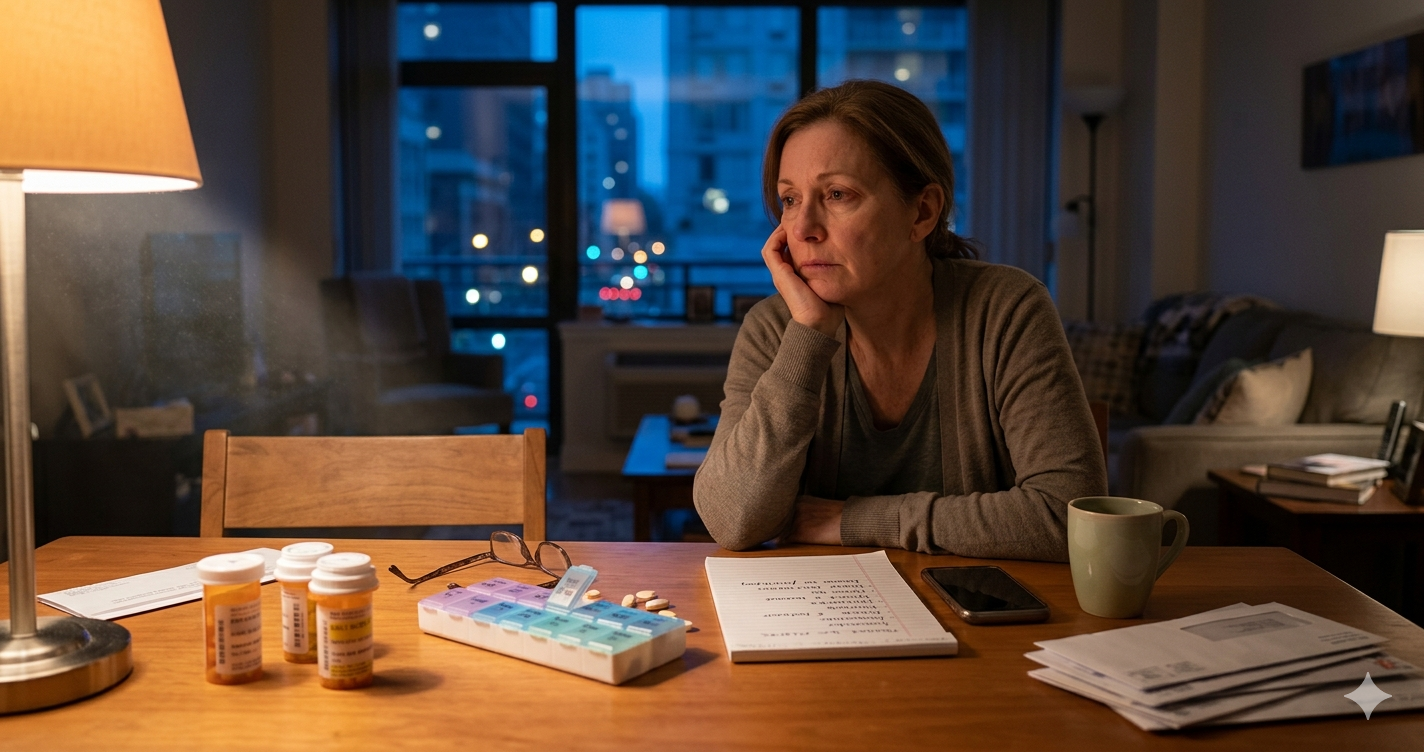
You didn’t notice when it started. You were just taking care of Mom — managing her medications, driving her to appointments, fielding calls from her doctor, rearranging your work schedule, sleeping a little less. Then a little less again.
At some point, you stopped being tired. You became something else entirely: numb, short-tempered, hollowed out. You’re still doing everything on the list. But the person doing it barely recognizes herself.
That’s caregiver burnout. And it’s far more common than most families talk about.
What is caregiver burnout?
Caregiver burnout is a state of physical, emotional, and mental exhaustion that results from the sustained demands of caregiving — particularly when those demands outpace the caregiver’s resources, support, and rest.
It is not a character flaw. It is not evidence that you don’t love your parent. It is the predictable result of caring too hard, for too long, without enough help.
According to the National Alliance for Caregiving, half of all family caregivers say the burden is “frequently” or “sometimes” too much to handle. More than half report feeling isolated. And more than one in five have been told by a health professional that they suffer from depression — nearly twice the rate of the general population.
Why burnout happens — and why it sneaks up on you
The problem with caregiver burnout is that it builds gradually, in the same increments as the caregiving itself. When your parent first needed a ride to the cardiologist, you said yes. When she needed help with her medications, you said yes. When it became clear she couldn’t manage the stairs alone, you said yes to that too.
Each step was reasonable. But the accumulation — the medical coordinator role, the financial manager role, the housekeeper role, the advocate role, the emotional anchor role — lands on one person’s shoulders before anyone has time to ask whether that’s sustainable.
I watched this happen in my own family. As my brothers and I cared for our mother through every phase of her decline, including her late-stage Alzheimer’s, I had to reckon with a cauldron of feelings: sadness watching someone I loved disappear by degrees; anxiety about what came next; and guilt — guilt for not doing more, guilt for taking a break, guilt for occasionally dreading the phone.
None of those feelings meant I was failing her. They meant I was human.
How to recognize the warning signs
The early signs of burnout are easy to dismiss as “just stress.” Watch for these:
Chronic fatigue — not ordinary tiredness, but the kind that sleep doesn’t fix. You wake up exhausted before the day has started.
Persistent irritability or depression — small things trigger large reactions. You cry more than usual, or you stop feeling much of anything.
Difficulty concentrating — you forget appointments, lose track of conversations, can’t hold a thought.
Physical symptoms — frequent headaches, stomach problems, weight gain or loss, recurring colds. Caregiver stress measurably weakens the immune system, according to research documented by the American Medical Association.
Withdrawal — you stop calling friends. Hobbies disappear. The world shrinks to the space between your home and your parent’s.
Neglecting your own health — you miss your own doctor’s appointments. You skip meals. Exercise hasn’t happened in months.
As I wrote in The CareGiving Navigator: self-care is a prerequisite to meeting each challenge you face, not a reward you earn once the work is done. The airline instruction is right — put your oxygen mask on first.
What to do when you recognize burnout
Name it. The act of saying “I am burned out” to yourself — or to a trusted person — breaks the invisible loop of shame and isolation that keeps burnout invisible.
Widen the circle. Effective caregiving almost always requires what I call care-partnering — sharing responsibilities with family members, professional caregivers, social service providers, and health professionals. Make a list of every task your caregiving involves. Then ask: who else could do any of these? When people offer to help, take them up on it.
Use respite care. Respite care is short-term care provided by a trained companion or professional so that you can step away — for an afternoon, a weekend, whatever you need. Many counties offer respite programs; your local Area Agency on Aging can connect you to local options. Many hospice programs also offer bereavement support and caregiver respite services.
Find a support group. I know from experience that finding time for a caregiver support group can feel impossible. But I’ve seen what happens for people who do. Groups — whether in person or virtual — provide something irreplaceable: the company of people who understand exactly what you’re carrying. Search for groups through your local Alzheimer’s Association chapter, hospital, or county aging office.
Talk to your doctor. Caregiver burnout has real physical consequences. If you’re experiencing persistent depression or anxiety, professional support is not optional — it is part of caring for the person who is caring for everyone else.
You are not alone
Too often, caregiving becomes a solitary endeavor. I wrote those words at the opening of The CareGiving Navigator because I had lived them. My brothers and I found our way through twenty years of caregiving together — imperfectly, exhaustedly, but together.
If you are reading this in the fog of burnout, I want you to know: what you’re feeling is not a sign that you’re doing this wrong. It’s a sign that you’ve been doing it alone for too long.
That’s fixable. But only if you let it be.
Start at CGNav.com to find resources, checklists, and guides to help you take the next step.
What are the signs of caregiver burnout?
The most common signs include chronic fatigue that sleep doesn’t resolve, persistent irritability or depression, difficulty concentrating, physical symptoms like frequent illness or headaches, social withdrawal, and neglect of your own health needs. Many caregivers also describe a sense of emptiness or loss of joy in things they used to find meaningful.
How is caregiver burnout different from regular stress?
Regular stress tends to ease with rest or a change in circumstance. Burnout is more pervasive — it affects your physical health, your emotional state, and your sense of identity. It builds gradually and usually requires active intervention to recover from, not just a good night’s sleep.
What should I do if I think I’m burned out?
Start by acknowledging it — to yourself and to someone you trust. Then take at least one concrete step: request respite care, call your county’s Area Agency on Aging, join a caregiver support group, or speak with your own doctor. You do not need to solve everything at once. One step at a time.
Can you prevent caregiver burnout?
You can reduce the risk significantly by building care-partnering structures early — distributing tasks among family members, using professional help, and scheduling regular breaks before you desperately need them. Recognizing the warning signs early and responding promptly also matters. Prevention is far easier than recovery.
Where can I find caregiver support?
Start with your county’s Office for the Aging, the Family Caregiver Alliance (caregiver.org), or the Caregiver Action Network (caregiveraction.org). The AARP Caregiving Resource Center offers tools, guides, and a toll-free support line (1-877-333-5885).
Sources
Free chapter: “Caring for the Caregiver” from Ron’s book, The CareGiving Navigator
The part most people skip, and shouldn’t. Send Ron’s chapter to your inbox.